
Published November 3, 2026
A 2-1 Buy What?! The Seller Trick That Can Slash Your Payment

When buyers are trying to make a monthly payment more manageable, one of the smartest questions they can ask is this:
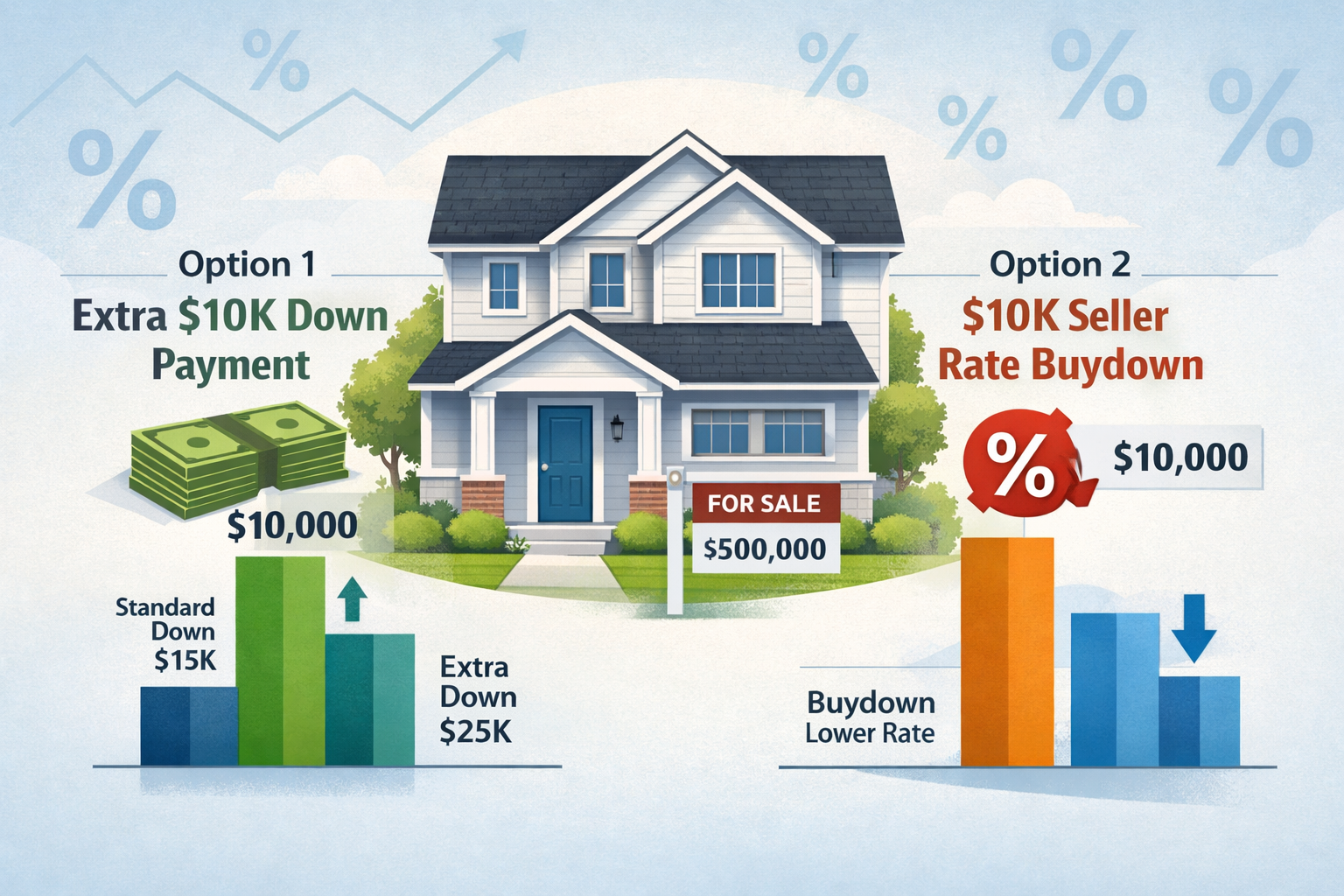
Is it better to put an extra $10,000 toward the down payment, or ask the seller for a $10,000 concession to help buy down the rate?
That is not the same comparison as a price reduction or a standard closing-cost credit. If the seller concession is specifically used for a rate buydown, it can absolutely help lower the buyer’s monthly payment.
Let’s walk through a clean example using:
- Purchase price: $500,000
- Down payment: 3%
- Loan type: 30-year conventional fixed
- Average mortgage rate used for this example: 7.25%
For this article, the buyer’s baseline down payment is 3% of $500,000, or $15,000. That means the starting loan amount is $485,000.
Baseline monthly payment at 7.25%
Using a 30-year fixed mortgage at 7.25%, the monthly principal and interest payment on a $485,000 loan is about:
$3,308 per month
This is principal and interest only. It does not include taxes, insurance, HOA dues, or mortgage insurance.
Option 1: The buyer adds another $10,000 to the down payment
If the buyer brings an additional $10,000 of their own money, the total down payment becomes $25,000 instead of $15,000.
That lowers the loan amount from $485,000 to $475,000.
At the same 7.25% rate, the monthly principal and interest payment becomes about:
$3,240 per month
Monthly savings compared with the baseline: about $68 per month
That savings is permanent for the life of the loan, assuming the buyer keeps that loan.
Option 2: The seller gives a $10,000 concession for a rate buydown
This is where the strategy can get more interesting.
If the seller gives a $10,000 concession and the lender allows it to be used for a rate buydown, that money may reduce the buyer’s monthly payment without requiring the buyer to bring that extra $10,000 out of pocket.
There are two important ways this can happen:
- Permanent buydown: the seller concession is used to purchase discount points and permanently lower the note rate
- Temporary buydown: the seller concession is used to temporarily reduce the payment for the first one or two years, such as a 2-1 buydown
Why I am not assigning an exact permanent buydown rate here
A permanent buydown does not have one universal price. The exact rate reduction a buyer gets for $10,000 depends on lender pricing, discount-point costs, lock timing, credit profile, and market conditions on that day.
So it would be misleading to invent a permanent rate outcome without real lender pricing.
What we can show accurately is how a temporary 2-1 buydown affects the monthly payment, because that is based on the note rate and payment math rather than guessed discount-point pricing.
Illustrative example: $10,000 seller concession used for a 2-1 buydown
In a typical 2-1 buydown, the buyer qualifies at the full note rate, but the payment is temporarily reduced:
- Year 1: payment based on a rate 2% lower than the note rate
- Year 2: payment based on a rate 1% lower than the note rate
- Year 3 and after: payment returns to the full note rate
Using the same $485,000 loan amount and a 7.25% note rate:
- Full note rate payment at 7.25%: about $3,308 per month
- Year 1 payment at 5.25%: about $2,678 per month
- Year 2 payment at 6.25%: about $2,986 per month
That means the temporary monthly savings would be about:
- Year 1 savings: about $630 per month
- Year 2 savings: about $322 per month
The estimated total subsidy needed to cover that 2-1 buydown on this loan is about $11,424 over the first two years.
That means a full 2-1 buydown on this exact example would likely require more than $10,000. So a $10,000 seller concession may not fully fund the entire 2-1 buydown, but it could still cover most of it, or it could be applied to a smaller temporary buydown depending on lender structure.
What lowers the monthly payment more?
If the comparison is:
- Extra $10,000 down payment, versus
- $10,000 seller concession used toward a temporary buydown
Then the seller concession can create a much bigger short-term monthly payment reduction, while the extra down payment creates a smaller but permanent monthly savings.
In this example:
- Extra $10,000 down: saves about $68 per month for the life of the loan
- Seller-paid temporary buydown: can save hundreds per month at first, but the savings expire
So the better strategy depends on the buyer’s goal.
Visual comparison
Monthly principal and interest comparison
Baseline, 3% down, 7.25% note rate, $485,000 loan
$3,308 per month
Buyer adds $10,000 down, loan drops to $475,000 at 7.25%
$3,240 per month
Savings: about $68 per month, permanent
Seller-paid temporary buydown, Year 1 payment at 5.25%
$2,678 per month
Savings: about $630 per month in Year 1
Seller-paid temporary buydown, Year 2 payment at 6.25%
$2,986 per month
Savings: about $322 per month in Year 2
Upfront cash-to-close comparison
Extra $10,000 down payment
Buyer brings $10,000 more out of pocket
$10,000 seller concession toward buydown
Buyer preserves that $10,000 cash
Which option helps a buyer more?
If the buyer wants the lowest payment right now, a seller concession used for a temporary buydown can create much bigger early monthly relief.
If the buyer wants a permanent payment reduction and is comfortable bringing in more cash, the extra down payment creates steady long-term savings.
If the buyer wants to keep more cash in the bank while easing into the payment, the seller concession strategy may be more attractive.
Important caveats
This example shows principal and interest only.
It does not include:
- Property taxes
- Homeowners insurance
- Mortgage insurance
- HOA dues
- Lender fees
Seller concessions and buydown structures are also subject to lender guidelines and loan-program limits.
And because permanent buydown pricing changes daily, buyers should always ask their lender for side-by-side quotes showing:
- Base note rate
- Permanent buydown options
- Temporary buydown options
- Extra down payment option
Bottom line
On a $500,000 purchase with 3% down and a 7.25% 30-year fixed rate, adding an extra $10,000 to the down payment lowers the monthly principal and interest payment by about $68 per month.
A $10,000 seller concession used for a rate buydown can reduce the monthly payment much more in the early years if it is structured as a temporary buydown, but that savings is not permanent. A permanent buydown may also help, but the exact result depends on lender pricing at the time.
The smartest move depends on whether the buyer’s priority is lower monthly payment today, lower monthly payment long term, or keeping more cash available at closing.
Explore Affordable Homes in Temecula Valley Now
Find Your Home Value NOW
Let’s get your blueprint for buying or selling your home!
Call or text Richard “Rick” Rodriguez at (951) 498-4456
Follow me on Youtube/IG @realtor_rick77.

Brian Erhahon
| Brian & Mercedes Erhahon, RESWealthy Team | REAL | PLACE
or another way